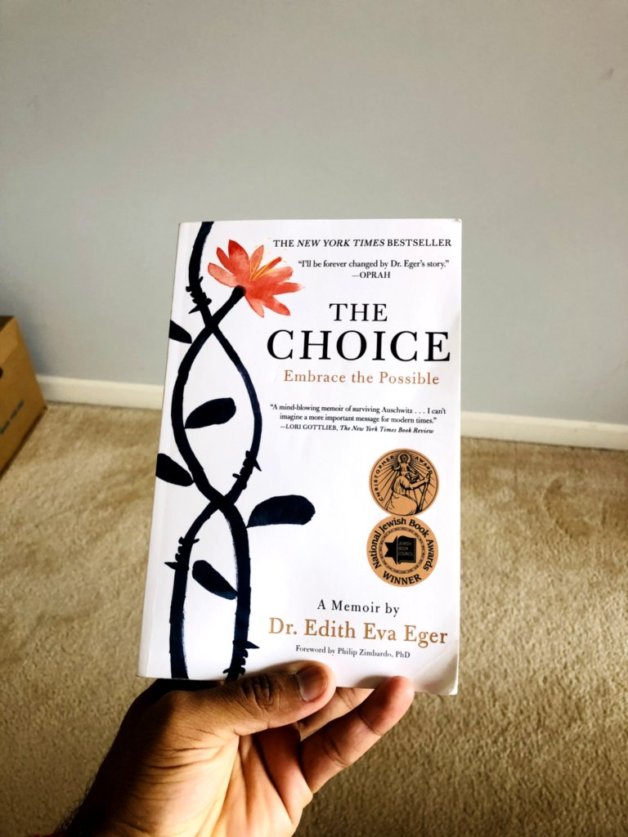
This was the 11th book I read in 2020.
I bought this because it was part of Bill Gates’ books list for Summer 2020. I was a little reluctant to buy it at first, since I had already read The Diary of a young girl, as both the books are written about the same topic.
At the end of reading this book, I was so wrong about my initial perspective and was pleased to know I put time and efforts to read and go through this book and author’s life experienences.
About the author
Kicking things off with the brief about the author. Dr. Edith Eva Eger.
When the author was a 14 year old teenager, she was sent to the concentration camp at Auschwitz, along with her sister Magda. The author was called “Eduka” by her sisters and mother. Being the youngest in the household, she had grown to be a sensitive little girl, who loved to spend time with her mother. She was the favorite of her father, and would discuss plethora of things with him. Her eldest sister Klara managed to escape the brutal experience that her sister faced in the Nazi regime.
Dr. Eger, throughout her life, has not only shown the grit that you need to survive, but has helped countless other people to follow her footsteps.
It is the work that she had done for the veterans, especially the ones who face PTSD, has gathered her accolades throughout the world and her TED talk is the one not to miss.
One takeaway from the book
There are so many wonderful things to discuss and talk about this book, but if you like to take one thing away from the book, I would definitely say the FOUR QUESTIONS that Dr. Eger grew up with. In the book, growing up, it was her duty to ask these four questions whenever there was a stressful situation in her house.
It doesn’t become clear as to why she was the one asking these four questions, but in the last 10 pages, she reveals that it is a Hungarian tradition for the youngest kid in the house to ask these four questions (for whatever reasons).
These four questions and their explanation go as follows.
1. What do you want?
2. Who wants it?
3. What are you going to do about it?
4. When?
At first these seem quite simple and straight forward questions to answer, but if you dissect these in details, you will realize the tremendous impact of these questions and the reasoning behind those. For those, you can flip through the pictures in the gallery below. The sixth picture in the gallery tells you the significance of those four questions.
It is safe to say that these four questions will remain with me throughout my life and I would try to remember them whenever I am not feeling confident and feeling like giving up.
These four questions are so profound that I am literally getting goosebumps just thinking about those.
The choice: what is Dr. Eger is talking about?
When I first started reading this book, I was faced with similar dilemma. What is the author trying to tell us? What message she is trying to tell us through the book and the title “The Choice”.
Dr. Eger reveals what she meant by The Choice in the penultimate chapter of the book. If you read this chapter, you are certain to get goosebumps as I did. The author has written this book and this chapter with so much care and attention to details, that you don’t hold yourself but imagine being at Auschwitz.
It was not evident to me why Dr. Eger chose to visit Auschwitz after decades. I didn’t understand why she chose to see the very place where her parents were brutally killed in the gas chamber by the Nazis. I didn’t get the idea of going through the same pain again, to experience something that happened decades ago.
I had no clue what was coming next.
Dr. Eger has mentioned in the book how her mother was sent to the gas chamber, how they were made to stand in a line and it was up to Mengele (Angel of Death) to decide who lives and who dies by suffocation in the gas chamber. When she mentions it the first time, it doesn’t feel that odd at first. When she revisits the same incident multiple times, you start to get curious why the author might be revisiting the same incident many times.
The author finally reveals what she had kept hidden throughout the book & when she finally reveals that, it just blew my mind.
The author explains – even after achieving so many things in life and helping numerous people get over their anxieties, depression, and other severe mental diseases, the author found it hard to forgive herself for the death of her mother.
When they were standing in line, Dr. Eger was the before her mother and sister. When Mengele asked Dr. Eger who the next person in line was to her, she froze. For a young teenager to ask that question and (probably) knowing the significance of that question, it was a question of life or death. The author mentioned that every part of her body wanted to say that her mother was her sister, so she could stay with her in the concentration camp at Auschwitz, but the actual word that came out was “Mother”.
This word was something that she had grown up with, calling her mother as Mother. Though she tried extremely hard, she couldn’t come up with a word “sister” for her mother, because of which Mengele sent her mother to the right side of the line and Dr. Eger and her sister to the left side.
Back then, nobody knew what was going to happen to them and what the meaning of those lines were. But, later the author realized the grave mistake she had committed and had been regretted throughout her life.
This was the reason she returned to Auschwitz to liberate herself from this burden of “possibly” causing the death of her mother. While explaining this experience, the author (very poignantly) tells reader that the prisons are within ourselves and it is up to us to liberate and free ourselves from those prisons. Nobody is going to free us from those internal prisons, but ourselves. And, that’s when the author makes “THE CHOICE” of freeing herself from this burden that she had been carrying throughout her life.
By returning to Auschwitz, she also proved that Hitler did finally loose, because after 3 decades, Hitler was dead and Dr. Eger was standing at the same spot that she did 3 decades ago.
It was really an awesome experience to read this chapter in particular and sort of relive those moments.
Apart from these two standouts, there were many moments that were as moving as any other moments. To be honest, if I write or talk about it, it will be too wordy and you might get bored of it.
I will leave a few bullets before I wrap this up.
– Dr. Eger’s life in Prison – something that is unfathomable
– Her physical transformation throughout World War II – I can’t even imagine going days and weeks without food
– The American soldier who saved her life and liberated her from Germany
– Her choice to go to America over an uncertain immigration to Israel
– Her daily struggles with the American life and blaming them on her husband, Bela
– Figuring things out slowly but eventually, divorcing Bela, remarrying him
– Helping thousands of people with their mental struggle
– Revisiting Auschwitz and finally liberating herself
Such a revolutionary book. I can’t express how important and moving this book was. Highly recommended!
See you at the next book review!
 stochasticity