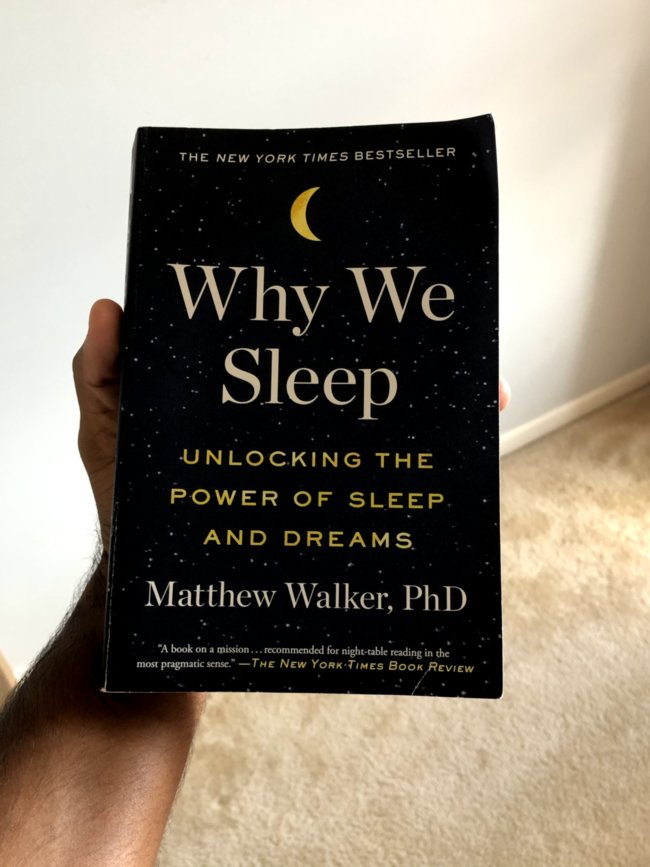
This was the 10th book I read in 2020.
It was the next logical book in my recommendation list after finishing the Grit. When we recently celebrated Rakshabandhan, Monika asked me what gift I would like to have and if you know me, you would know that I *only* love books as gifts, so there we are with Atomic Habits by James Clear.
This book is an extension of what I have read in some of the previous books like Grit, the 5 AM Club, etc. I have been reading a lot of books on self/personality development and life hacks to live a better, stronger, and healthier life & this book definitely helped me with so many messages which are etched into my mind for eternity. Let us see if I can break those down in a few words.
The common theme throughout the book
The book talks about only one thing – why you should sleep at least 8 hours every night, without missing a single night! – Plain & simple.
There is no easy way to explain what this talks about. The author has gone through extreme measures to explain the disastrous effects of sleep loss on a human body & most importantly human brain. The more important thing is that he is not talking out of just presumption, but citing the studies and experiments dating prior to 19th century. In short – the author knows what he is talking about.
For me, personally, this book has been a guiding light for my sleep and wake schedule. I am and will follow whatever guidelines the author has mentioned in this book to lead a happy, healthy, and peaceful life.
Let us begin with the review, shall we?
To go through the learnt lessons from this book, I decided to put my thoughts in a different way – in a (Q)uestion & (A)nswer way. The book is very technical and someone like me who was not aware about the science behind the sleep, it took a lot of time to finish the book and more often than not, I had to reread a few paragraphs just to understand what the author was trying to say.
Having said that, the book is very nicely written and author has given enough examples to explain what actually goes on in your brain.
Let’s start then?
Q – As an adult, how many hours of sleep I need?
A – A minimum of 8 hours of uninterrupted sleep.
Q – Is it okay if I can’t get 8 hours of sleep every night?
A – No. You must get at least 8 hours of uninterrupted sleep each night.
Q – Can I get back the lost sleep? For example – if I slept 7 hours tonight and 9 hours tomorrow night, will that work?
A – No. You can’t get back the lost sleep. Sleep is not like a credit card balance, which you can pay up with a payment in the future. Once you lose an hour of sleep, that’s it. You lost it. There is no way of getting that 1 hour of lost sleep back.
Q – Why the Guinness Book of World Records has condemned/cancelled the record for the most number of hours being awake (without sleep)?
A – Because the Guinness Book of World Records knows the devastating effects of sleep loss on a human body. They cancelled/condemned the world record for this to make sure nobody tries for this *unhealthy* and *dangerous* record, which can ultimately lead to someone’s death.
Q – What are the disadvantages of sleep loss?
A – There are plenty. To name a few – Obesity i.e. weight gain, dementia, headaches, high blood pressure, heart attack, blurry vision, car accidents, and what not.
Q – What are the things I should pay attention to if I want to sleep nicely for at least 8 hours a night?
A – There are many things that we can pay more attention to improve the 8 hour uninterrupted sleep.
For starters –
1. Make sure the bedroom is cold and not hot. The ideal temperature of the bedroom should be 65F (18-19C).
2. Make sure there are no blue/bright lights in the bedroom when you are trying to sleep. I like to keep my bedroom pitch dark to have an uninterrupted sleep.
3. Make sure there are no visible clocks in your bedroom. This helps you sleep calmly and not think about the day which you have planned ahead. I know it sounds counter intuitive, but this really works for me.
4. Make sure there are no electronic devices in your bedroom. I like to keep my phone outside my bedroom, so that I am not disturbed by things going on in different time zones, as my friends and family are scattered across the globe.
5. Your body temperature helps you fall asleep faster. Due to this reason, you shouldn’t exercise 2 hours prior to your bedtime. If you exercise, your body gets warmed up and your body temperature might stay above the required for you to fall asleep. If needed, a quick shower/bath with hot water is highly recommended. After the hot bath, your body starts to cool down, which ultimately helps you to fall sleep faster.
6. If you are not able to fall asleep faster, try to read a book on you bed. It will help in some way.
7. Don’t drink too much water before the bedtime. This will avoid getting up in the middle of night to urinate.
8. Make sure to eat light dinner before the bedtime. This will ensure you don’t wake up in the middle of the night to use the bathroom.
9. No smoking. No drinking alcohol. This is no brainer.
Q – Is dreaming good? Should we be dreaming while sleeping?
A – Dreaming is good. If you had a dream (be it good or bad), it is an indication that you had a good night’s sleep.
If you had a good dream – it means your brain is processing the happy thought and you might be smiling (physically) or enjoying (in your dream).
If you had a bad dream a.k.a. a nightmare – it means your brain is processing the sad or unhappy memories from the day or the past. It is a positive thing since you are (in a way) facing your failures, fears, and unhappiness. It is one of the ways of getting over the failures (personal and professional) in the past.
Q – Are sleeping pills good for our sleep?
A – No. NOT AT ALL. Sleeping pills don’t benefit us with the type of sleep that we need. They give a feeling of fabricated sleep, which doesn’t benefit us in any way.
Q – Is coffee good to stay awake? How many cups and when should we have coffee?
A – I am a coffee connoisseur. This was the biggest takeaway for me from this book. The author mentions that your body needs at least 8 hours to process the caffeine present in coffee; Therefore, you must avoid having coffee after 12PM. I used to have a couple cups of coffees – the first in the morning at around 10AM and the second one at around 3PM. The day I read this in the book, I cut down my second cup of coffee and am surviving only on the single cup of coffee that I take at 10AM. I couldn’t be prouder of myself. 🙂
Q – Is alcohol good for your sleep?
A – No. Alcohol in any way is not good for your sleep. You might think that you fall asleep faster when you consume alcohol, but that’s just a myth.
In the past, I had been a big consumer of alcoholic drinks, which dropped to only a few in a month due to my running and CrossFit, which has dropped down to almost zero now, after reading this book.
Q – What is the takeaway from this book?
A – In fact, there are 12.
Here they are –
1. Fix sleep and wake time.
2. No exercise 2-3 hours before your bedtime.
3. No coffee after 12 PM.
4. No alcohol before bedtime. Best thing – no alcohol at all.
5. No large beverages and food before bedtime.
6. No sleeping pills or medicines that disrupt your sleep.
7. No naps after 3PM.
8. Relax/Meditate before the bedtime.
9. Hot bath before the bed.
10. No lights, No electronic gadgets, Cold temperature in the bedroom.
11. Keep the window shade open, so that you are greeted naturally when you wake up.
12. If you are up, don’t just lie awake in bed, get out of the bed, and get moving.
Conclusion
The author mentioned in the book that if you want to take one piece of advice from this book, it will be – “Fix your sleep time and wake up time“. Fixing this one thing will help you revolutionize the way you live. I will conclude with the same.
It was an awesome book and a highly recommended one if you want to take charge of your life.
See you at the next book review!
 stochasticity