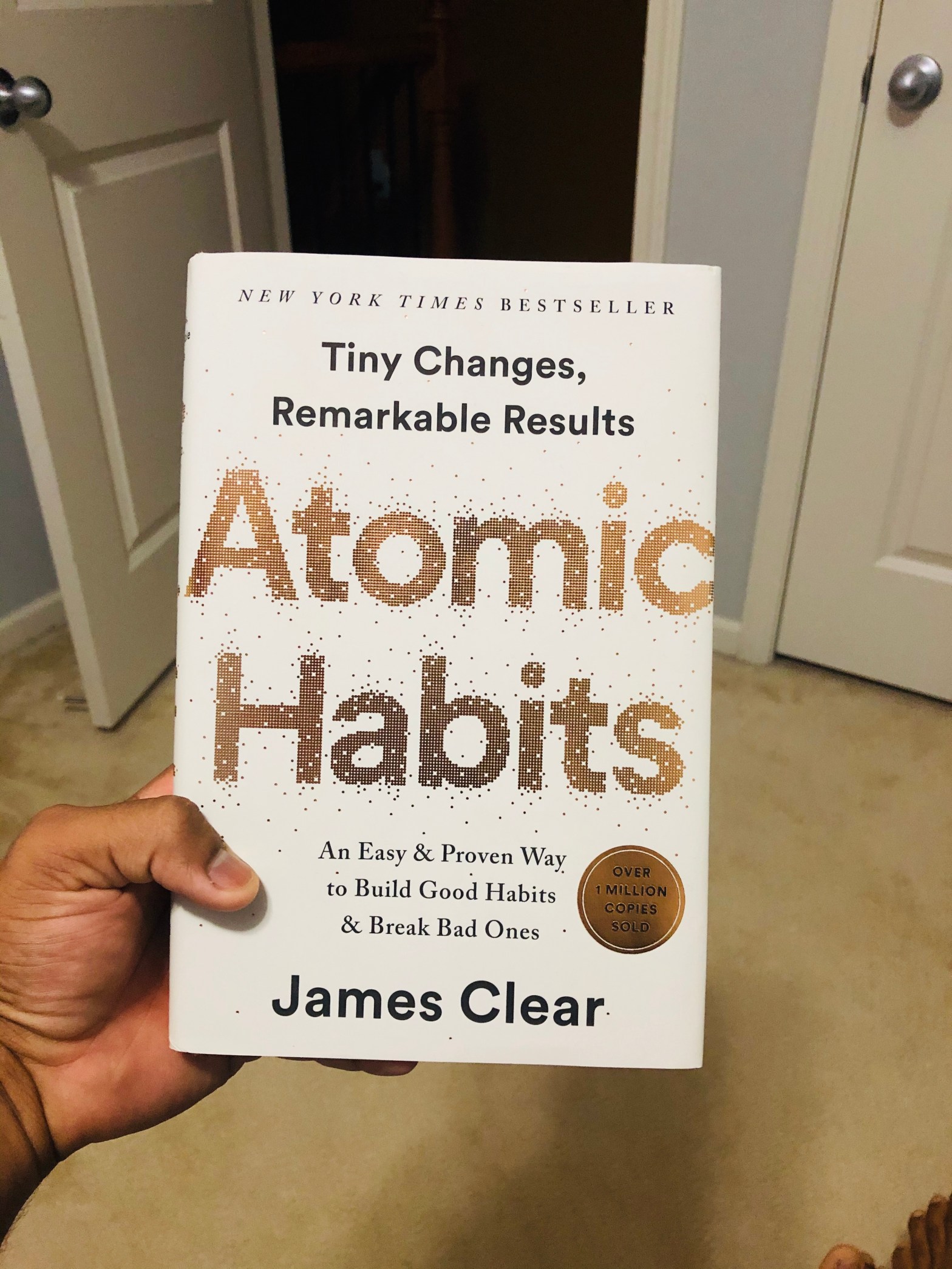
This was the 9th book I read in 2020.
It was the next logical book in my recommendation list after finishing the Grit. When we recently celebrated Rakshabandhan, Monika asked me what gift I would like to have and if you know me, you would know that I *only* love books as gifts, so there we are with Atomic Habits by James Clear.
This book is an extension of what I have read in some of the previous books like Grit, the 5 AM Club, etc. I have been reading a lot of books on self/personality development and life hacks to live a better, stronger, and healthier life & this book definitely helped me with so many messages which are etched into my mind for eternity. Let us see if I can break those down in a few words.
The common theme throughout the book
There is one single message the author is trying to convey throughout the book and to put that in brief – “tiny changes, remarkable differences”. Please allow me to explain. The author is telling us to make a few tiny changes in our daily life, which (over time) will become your habits and eventually cause a big and positive difference in your life.
To buttress this analogy, the author has given so many examples throughout this book and that’s what I loved the most about it – the author has started each chapter with a story, which a normal human brain remembers than the actual message itself.
There are so many stories to share on this piece, but, I would refrain myself from doing that (in the interest of both time and the length of this blog post).
Four laws of habit
The author mentioned the four laws of habit and I agree with him on this. There were so many things that I do without even realizing, which, the author was quick to point out. I guess that’s how human nature is.
The author mentioned if you are doing something new or developing a new habit, your mind and body will take time to get used to it; but, if you have a habit which is ingrained in you, your brain and body wouldn’t even realize that you are doing it; that’s the magic of habits. The author’s goal throughout this book is to help you take your body and mind from difficult to do something to not realizing doing something. It is just a magical process.
While doing this, the author has mentioned four laws that we *should* use to ingrain a new habit. These four laws and their basic descriptions are –
1. Make it Obvious – whichever habit you want to constitute, you must make it obvious. For example: putting important things in front of your eyes (on your desk) so that you don’t forget them whenever you go out until it becomes your habit. I do that with my car keys, wallet, and phone.
2. Make is Attractive – once the habit is obvious but still you are not motivated to follow it, you must make it attractive. For example: tell yourself, if you do this habit, promise yourself a pleasant activity *only* after you do this habit/exercise, etc.
3. Make it Easy – this is the most important law. If the habit that you want to follow/ingrain is not easy, then your brain will not tell you to follow this habit, so it is very important to make the habit easy.
4. Make it Satisfying – once the habit is achieved, you must reward yourself. This is very important if you want to come back to this habit because if you reward yourself soon after installing this habit, your brain will associate this habit with the satisfying feeling of the reward, which will help you perform this habit even more.
You can find examples of these four laws in the pictures at the end of this blog post.
2-minutes Rule
This is a revolutionary method of thinking and tricking your brain to allow your body to do some task or install a habit. Instead of boring you with details – the crisp idea behind this rule is – YOU CAN BREAK DOWN ANY ACTIVITY/HABIT IN 2-MINUTES. IF YOU CAN DO IT IN 2 MINUTES, YOU CAN INSTALL THAT HABIT.
I know it sounds weird, funny, and incorrect at first, but let me give you an example. I would quote the author’s example from the book. If your goal is to run a marathon, then here’s how you will break it down according to the 2-minutes rule.
- Phase 5 – Running a Marathon (~6 hours)
- Phase 4 – Running a 5K (~45 minutes)
- Phase 3 – Walking some 10,000 steps (~35 minutes)
- Phase 2 – Going out for a 10-minute walk (~10 minutes)
- Phase 1 – Putting on your running shoes (~2 minutes)
As you can see, the author is trying to tell us to focus on Phase 1. With a 2-minutes rule, you are telling your brain to just putting on your running shoes. Once you put it on, the next logical activity the brains gets involved is telling you that you already put the shoes on, you might as well go for a 10-minute walk, followed by a few steps, then a 5K, and eventually a Marathon distance. Obviously, this is *not possible* in the first attempt itself, that is why we are more focused on developing this habit. Every time, you put your running shoes on, you will remember your brain telling you to go out for a walk and then eventually more distance.
Habit Installation Protocol
The author mentioned this during the initial part of the book and to keep it short, the habit installation protocol goes like this
Syntax -> I will [HABIT] at [TIME] in [LOCATION]
Example -> I will READ A BOOK at 5.20AM in MY BEDROOM.
The author tells you if you just tell yourself that you will read a book (without time and location), at the time of actually reading a book, your brain will start to procrastinate and come up with excuses for not reading a book. If you specifically tell your brain to read that book at a particular time in a particular location, it will remember and trigger you to read it. You can couple it with other habits, which brings us to Habit Stacking.
Habit Stacking
If you successfully implemented the Habit Installation Protocol, the next step is to stack habits. The author (very cleverly) put these two ideas together so that we can easily relate those to one another.
The central idea of Habit Stacking is if you ingrained a habit successfully, it is time to couple it with a new habit so that there would be an association of these two habits, which the brain would think go together and you would eventually end up doing.
I would revisit the above example here as well. It goes like this.
Syntax -> I will [HABIT1] at [TIME1] in [LOCATION1/2] & after that, I will [HABIT2] at [TIME2] in [LOCATION1/2]
Example -> I will READ A BOOK at 5.20AM in MY BEDROOM & after that, I will EXERCISE at 6AM in BASEMENT.
It sounds such a simple and easy and attractive and obvious (four laws of habit) change and that’s why the brain/mind is tricked into installing and stacking these habits.
While mentioning this, the author also pointed out to *always* do some hard thing before the *already ingrained* habit to act as a motivation. For example, if exercising is hard for you and reading is easy, reverse the habit1 and habit2 in the above formula and you will see better results.
Conclusion – Focus on the SYSTEM, not on the GOAL
This is a good point for the conclusion. Throughout the book, the author has stressed how important it is to focus on the system and minute details instead of just achieving the goal. While mentioning this, he didn’t downplay the goal-setting strategy, which is important.
He just asked a simple question to prove his point – WHAT HAPPENS AFTER YOU ACHIEVE A GOAL? It hit me so hard because it is so true. When I was doing 30-days 100 push-ups challenge, I was just focused on the goal and not the system. If I would have focused on ingraining it as a habit, I would still be doing that. Alas, that’s not the case right now. The point I am trying to make here is to be a healthy person with a healthy lifestyle instead of focusing on achieving a goal for just 30 days.
I am glad that this has improved me mentally for my running. I can see that I have become a runner, instead of focusing on running certain miles per week. Let us see till when it lasts.
This sounds like a good spot to stop. Please check out some pictures from the book itself.
See you at the next book review!
 stochasticity